

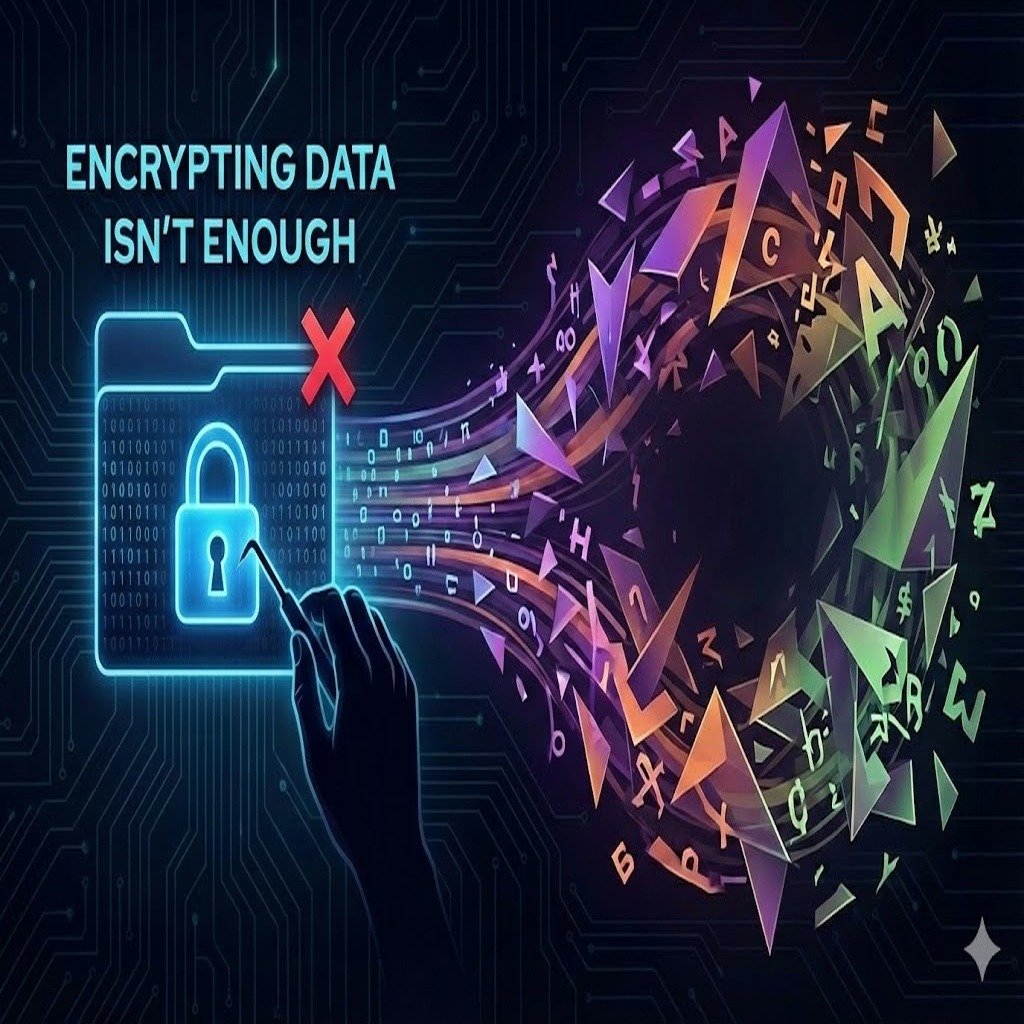
Why Encrypting Data Isn’t Enough—Making User Data Unintelligible by Design
For years, encryption has been the security world’s favourite comfort blanket.
Encrypt the data. Lock it down. Sleep better at night.
But here’s the uncomfortable truth most enterprises are now facing: encrypted data still gets breached, misused, and exploited—every single day.
If encryption were enough, breach headlines would be a thing of the past. They aren’t. And that tells us something important.
Let’s talk about why encryption alone no longer cuts it, and why making data unintelligible by design is becoming the next big shift in identity and data security.
The Encryption Comfort Myth: Beyond the False Sense of Security
For decades, encryption has been the “gold standard” of the security playbook—a mathematical shield that feels impenetrable. When organizations encrypt data at rest and in transit, they often check a box and assume the job is done. However, this confidence is increasingly misplaced as attackers evolve beyond trying to “break” the math.
The “Harvest Now, Decrypt Later” (HNDL) Threat
The old assumption was that encrypted data is useless to a thief. That is no longer true. We are now seeing the rise of Harvest Now, Decrypt Later.
State actors and sophisticated hacking groups are proactively exfiltrating massive amounts of encrypted data today, even if they can’t read it yet. They are banking on the future: as quantum computing advances, the encryption protocols of today will likely fall, allowing them to unlock years of historical secrets retroactively.
Why Encryption Isn’t a Cloaking Device
Even when your data remains “unbreakable,” encryption does not make it invisible. Modern attackers use Traffic Analysis and Metadata Profiling to bypass the shield:
- Database Mapping: Even without the keys, hackers can analyze encrypted database blobs to determine the exact number of user records, the frequency of updates, and the size of the dataset. This allows them to value their “haul” before they even crack it.
- The Vulnerability of Use: Data must be decrypted to be processed. This “moment of use” is the primary target for memory scraping and side-channel attacks.
- Architectural Leaks: Encryption often hides the content but reveals the context. An attacker can see that a high-volume encrypted stream is heading to a specific payroll API, identifying exactly where the most valuable assets live.
The Reality Check
Encryption is a necessary layer, but it isn’t a vault. It’s a delay tactic. If your security strategy ends at encryption, you aren’t protecting your data—you’re just archiving it for a future breach.
The SaaS Sprawl: Multiplication of the Attack Surface
While “Harvest Now, Decrypt Later” targets the data itself, SaaS Sprawl targets the infrastructure. In a modern enterprise, PII is rarely isolated. It is synchronized, exported, and duplicated across a web of interconnected platforms—from CRM systems and marketing automation tools to “productivity” plugins and shadow IT apps.
Every time a user connects a third-party app to your core environment, they aren’t just granting access; they are often creating a “Shadow Data” duplicate. A hacker doesn’t need to breach your heavily fortified core database if they can find one less secure, niche application with a “read-all” permission. This is the Weakest Link Strategy: attackers look for the smallest, least-managed app in your ecosystem that contains a synced copy of your user records. Once that app is compromised, they can exfiltrate the same high-value PII as if they had hit the main server, often without triggering the primary system’s alarms.
The PII Visibility Gap
Even if your primary systems are locked down, duplication creates a visibility gap that hackers exploit:
- Credential Lateral Movement: A breach in a small, third-party tool often yields valid user emails and metadata that can be used for highly targeted phishing or credential stuffing against your main environment.
- Shadow Data Persistence: When an employee leaves or a project ends, the data in niche apps often remains. These “toxic logs” and abandoned databases become sitting ducks for attackers.
- The “Mirror” Effect: Many integrations require a full mirror of your user list to function. This means your attack surface isn’t just one system.
The Reality: In a SaaS-heavy world, your security is only as strong as the most obscure app your marketing team signed up for during a free trial.
Real-world breaches where encryption didn’t save the day
Look at major breaches over the last decade.
In many cases, attackers didn’t break encryption. They simply logged in.
Stolen credentials. Misconfigured access. Overprivileged accounts.
The data was encrypted right up until it was handed over, nicely decrypted, to someone who shouldn’t have seen it.
Encryption wasn’t broken.
Trust was.
What Encryption Actually Solves—and What It Doesn’t
Encryption protects data at rest and in transit
To be clear, encryption is essential.
It prevents raw data from being read if storage is stolen or traffic is intercepted.
That’s table stakes. No serious security strategy skips this step.
But encryption solves a very specific problem, not the whole problem.
Who can still read the data once decrypted
Once decrypted, the data is readable by:
- Applications
- Administrators
- APIs
- Third-party tools
- Anyone with valid (or stolen) access
At that point, encryption steps aside.
If access controls fail—and they often do—your most sensitive data becomes instantly usable.
Insider threats and compromised credentials
Not all threat actors wear black hoodies.
Disgruntled employees, careless insiders, or attackers using stolen credentials don’t need to hack anything. They just walk through the front door.
Encryption doesn’t stop them. It was never designed to.
The illusion of safety once keys and access exist
Encryption keys, access tokens, and permissions create a fragile trust chain.
Break one link, and the entire system is exposed.
That’s why relying solely on encryption creates an illusion of safety—one that disappears the moment access is abused.
The Real Problem: Readable Data Everywhere
Data duplication across SaaS apps and platforms
Modern enterprises love SaaS.
CRM here. HR tools there. Collaboration apps everywhere.
But each tool often stores its own copy of user data.
Same PII. Multiple places. Multiple risks.
More copies mean more attack surfaces.
Identity sprawl and excessive data exposure
Every app needs identities.
Every identity needs access.
Every access increases exposure.
Over time, identity sprawl turns into a tangled mess of permissions that no one fully understands.
And readable data flows freely across it.
Why IAMs secure access—but not data usability
IAM solutions are excellent at answering “Who can log in?”
They’re far less effective at answering “What can be done with the data once access is granted?”
IAM controls doors.
It doesn’t control what happens inside the room.
How readable data amplifies breach impact
When attackers gain access to readable data, damage scales instantly:
- PII gets sold
- Accounts get hijacked
- Trust evaporates
The problem isn’t just the breach—it’s the usability of the data after the breach.
From Encrypted to Unintelligible: A Security Mindset Shift
What “unintelligible by design” really means
Unintelligible data isn’t just locked—it’s inherently useless without the right context.
Even if attackers access it, what they see doesn’t help them.
No clear names.
No readable identifiers.
No exploitable information.
That’s the heart of unintelligible data security.
Making data useless—even after access is gained
This is the mindset shift.
Instead of assuming breaches won’t happen, assume they will—and design systems so breaches don’t matter.
If attackers can’t understand the data, they can’t monetize it, misuse it, or weaponize it.
Encryption vs obfuscation and tokenization
Encryption hides data until it’s decrypted.
Tokenization and obfuscation replace sensitive data entirely.
The real data stays protected elsewhere. What apps and attackers see is meaningless without controlled resolution.
This drastically reduces exposure.
Reducing breach impact, not just preventing breaches
Prevention will never be perfect.
Impact reduction is where modern security wins.
Unintelligible data turns catastrophic breaches into contained incidents.
Privacy-by-Design Identity Protection
Embedding privacy at the identity layer
Privacy can’t be an afterthought.
It has to live where identity and data meet.
By protecting user data at the identity layer, organizations prevent unnecessary exposure across systems.
Protecting PII without breaking user experience
Here’s the good news: users don’t need to see raw PII for systems to work.
Smart architectures protect sensitive data while preserving seamless experiences—no friction, no slowdown.
Security without usability loss is no longer optional.
Minimizing data exposure across enterprise tools
Do all apps really need full user data?
Usually, no.
Privacy-first design ensures apps get only what they need—and nothing more.
Supporting compliance without extra complexity
Regulations like GDPR and DPDP demand data minimization and protection.
Unintelligible data security supports compliance naturally, without turning security teams into compliance firefighters.
How Unintelligible Data Strengthens Cyber Resilience
When breaches become non-events
Imagine a breach where attackers get data—but it’s useless.
No headlines.
No panic.
No emergency war rooms.
That’s resilience.
Lower financial, legal, and reputational risk
If stolen data can’t be understood, it can’t cause harm.
That reduces fines, lawsuits, and customer churn—often the most expensive part of any breach.
Faster incident response and smaller blast radius
Security teams can focus on fixing access issues instead of damage control.
Less exposure means faster recovery and fewer long-term consequences.
Alignment with Zero Trust principles
Zero Trust assumes no implicit trust—ever.
Unintelligible data fits perfectly into this philosophy by ensuring data remains protected even when trust fails.
Encryption + Unintelligibility: The Winning Combination
Why this isn’t an either/or decision
This isn’t about replacing encryption.
It’s about completing it.
Encryption protects storage and transit.
Unintelligibility protects usage and exposure.
Together, they form a modern defense.
Complementing IAMs with privacy-first controls
IAMs decide who gets access.
Unintelligible data controls what that access reveals.
That’s how identity security evolves beyond login screens.
Building layered protection that actually works
Layered security isn’t about stacking tools.
It’s about covering gaps.
Unintelligible data fills one of the biggest gaps encryption leaves behind.
The Future of Identity Security
Why next-gen platforms go beyond authentication
Authentication is just the starting point.
Future-ready platforms focus on:
- Data minimization
- Privacy by default
- Breach impact reduction
Identity security is becoming data-centric.
Identity evolution toward privacy-first architectures
As identity moves from centralized to distributed environments, privacy-first design becomes critical.
Systems must assume compromise and still protect users.
What security leaders should demand
CISOs and security leaders should ask:
- Is our data still safe after access is granted?
- Can attackers actually use what they steal?
If the answer is yes, it’s time to rethink the approach.
Security Isn’t About Locks—It’s About Making Data Useless outside your app
Encryption will always matter.
But it’s no longer enough on its own.
Modern threats don’t break locks—they exploit trust, access, and readability.
By embracing unintelligible data security, organizations change the rules of the game. Breaches stop being disasters and start becoming manageable events.
In the end, the strongest security strategy isn’t about building taller walls.
It’s about making sure that—even if someone gets inside—there’s nothing valuable they can use.
And that’s the future Keywix is building toward:
security that doesn’t just protect data, but renders it useless to anyone who shouldn’t have it.