


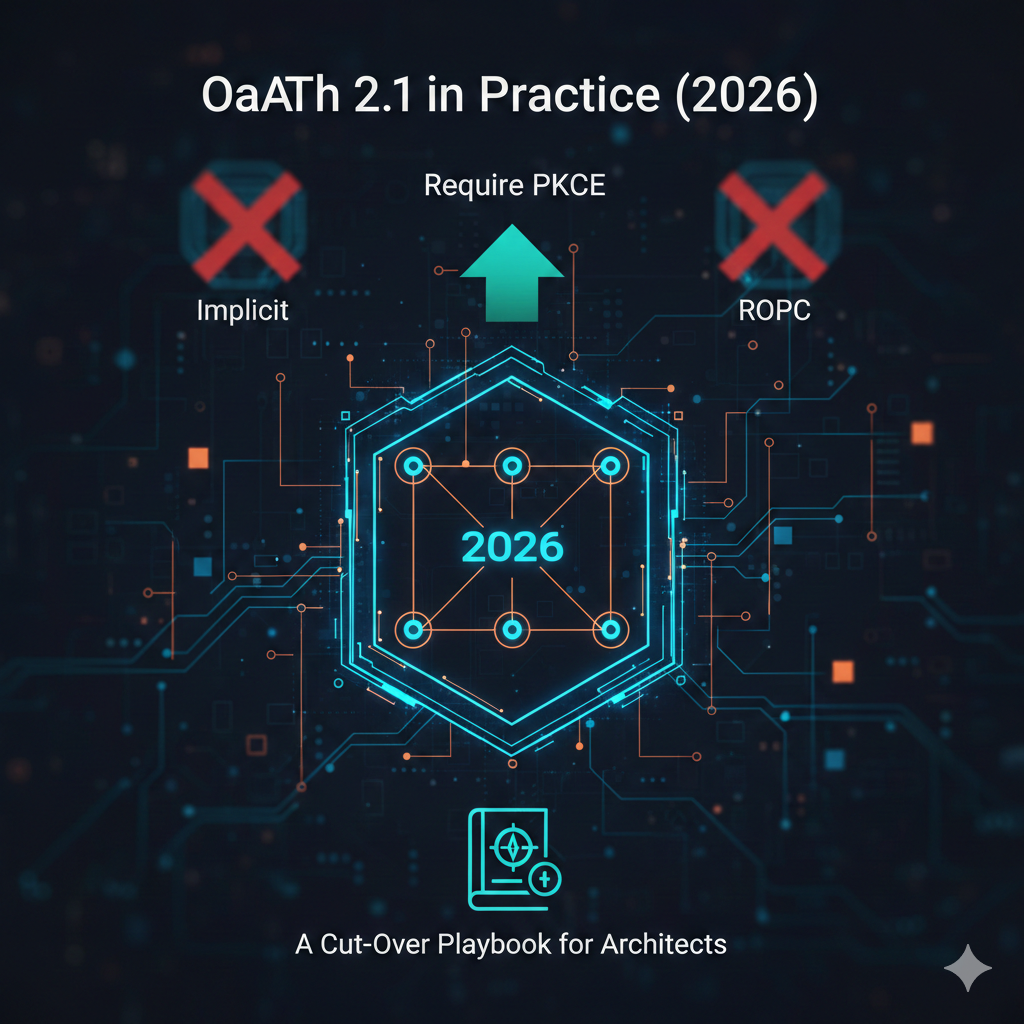
OAuth 2.1 in Practice (2026): Kill Implicit & ROPC, Require PKCE — A Cut-Over Playbook for Architects
If you’re an IAM or application security architect in 2026, OAuth 2.1 is no longer something you can safely “keep an eye on.” It’s already shaping how identity platforms behave, how security teams audit applications, and how modern apps are expected to authenticate users and services.
OAuth 2.1 doesn’t introduce a brand-new protocol. Instead, it consolidates more than a decade of hard security lessons into a simpler, stricter core. Flows that were repeatedly abused are removed. Protections that used to be optional are now mandatory. Ambiguity is intentionally stripped away.
For architects searching “OAuth 2.1 changes” or “migrate implicit flow,” the real question isn’t what changed, but how quickly you can move without breaking production systems or developer workflows.
Why OAuth 2.1 Exists
OAuth 2.0, published in 2012, was designed to be flexible. That flexibility helped it scale across web apps, mobile apps, SPAs, APIs, and even CLIs. Unfortunately, it also led to insecure interpretations that became widespread before the ecosystem fully understood the risks.
Over time, the IETF released multiple documents to patch these issues: PKCE, Security Best Current Practice, browser-based app guidance, and stricter redirect URI handling. The problem was fragmentation. Architects had to read several RFCs just to understand what “secure OAuth” meant in practice.
OAuth 2.1 solves this by folding those documents into a single, opinionated baseline. Instead of “you may” or “you should consider,” the spec now says “this is required” or “this is no longer allowed.” That shift alone is why OAuth 2.1 matters.
What OAuth 2.1 Removes — and Why It Matters
The most visible change is the complete removal of the Implicit flow. Originally intended for browser-only applications, Implicit was a workaround for a world that didn’t yet have PKCE. Tokens were returned directly via the browser, which exposed them to history logs, referrer headers, JavaScript injection, and malicious extensions. In real environments, this became an easy target.
OAuth 2.1 formally eliminates Implicit flow. Any application still using response_type=token is now relying on a pattern the standards community considers fundamentally unsafe. The modern replacement is Authorization Code flow with PKCE, even for SPAs.
Resource Owner Password Credentials (ROPC) is also gone. While it was meant for highly trusted first-party apps, in practice it encouraged applications to collect usernames and passwords directly. That expanded credential attack surfaces, weakened MFA adoption, and made phishing resistance nearly impossible. OAuth 2.1 removes ROPC to draw a clear line: if your app handles passwords, OAuth is no longer the right abstraction.
These removals are not theoretical cleanups. They directly reflect how OAuth has been attacked in the real world.
What OAuth 2.1 Makes Mandatory
The most important requirement in OAuth 2.1 is PKCE. Proof Key for Code Exchange is no longer optional or “recommended.” It is required for all public clients, including SPAs and mobile apps.
PKCE prevents authorization code interception by binding the code exchange to a cryptographically random verifier generated by the client. Even if an attacker steals the authorization code, they can’t redeem it without that verifier. This single requirement eliminates a large class of OAuth attacks that were previously considered edge cases.
Redirect URI handling is also much stricter. OAuth 2.1 disallows wildcard redirects, partial matching, and dynamically supplied redirect URIs. Redirects must be explicitly registered and matched exactly. This change shuts down many token leakage attacks that exploit open redirects or URI confusion.
The spec also aligns more clearly with modern browser realities. Browser-based apps are expected to use Authorization Code with PKCE, avoid long-lived tokens in the browser, and treat token storage as a high-risk activity. OAuth 2.1 no longer pretends that SPAs can be secured the same way as confidential server-side clients.
Why Architects Should Act Now
Although OAuth 2.1 is still an active draft on datatracker.ietf.org, the ecosystem has already moved. Major identity providers increasingly disable Implicit flow by default, mark ROPC as legacy, and enforce PKCE automatically. Security assessments routinely flag wildcard redirect URIs and browser-stored tokens as critical findings.
Waiting for OAuth 2.1 to reach final RFC status is risky. By then, deprecated flows will already be operational liabilities, not just compliance gaps. From a security architecture perspective, OAuth 2.1 represents the new baseline, not an experimental future.
A Practical 30 / 60 / 90-Day Migration Plan
In the first 30 days, the priority is visibility. Architects should inventory OAuth clients across environments and identify where Implicit flow, ROPC, missing PKCE, or loose redirect URI rules are still in use. Logging and usage analysis often reveal forgotten admin tools, internal dashboards, or legacy mobile apps that quietly depend on deprecated patterns. Communication with development teams is critical at this stage, but production behavior should remain unchanged.
Days 31 to 60 are about reducing real risk. SPAs should migrate from Implicit to Authorization Code with PKCE, which in most modern frameworks is largely a configuration change. Applications using ROPC require deeper redesign, often moving to redirect-based authentication or service-to-service flows for backend jobs. Redirect URIs should be locked down, and token lifetimes reviewed with refresh token rotation enabled where supported.
By days 61 to 90, enforcement becomes realistic. Deprecated flows can be disabled, PKCE can be required globally, and wildcard redirect URIs can be rejected outright. At this stage, OAuth becomes predictable again, which is exactly what security teams want.
The Keywix Perspective: Reducing Risk After OAuth
OAuth 2.1 significantly improves how authorization is performed, but many breaches still occur after tokens are issued. Applications frequently store identity attributes, user profiles, and session data long after they are needed.
This is where Ensto by Keywix offers a complementary approach. Instead of encouraging apps to persist identity data post-OAuth, Ensto minimizes what applications ever store. Identity context is fetched only when required, scoped tightly, and not duplicated across services.
For architects, this means a smaller breach blast radius, fewer compliance concerns, and less sensitive data sitting at rest inside applications. OAuth 2.1 hardens the front door, while Ensto reduces what’s worth stealing inside.
Final Thoughts
OAuth 2.1 is not about adding complexity. It’s about removing unsafe choices and making secure behavior the default. By eliminating Implicit and ROPC, mandating PKCE, and tightening redirect handling, the spec aligns with how OAuth is actually used and attacked today.
For IAM and app-security architects, the real risk in 2026 isn’t migrating too early. It’s being the last team still justifying legacy flows because “they haven’t caused issues yet.”